20 Best Things To Do In Ha Giang Vietnam
Ha Giang is home to some of the most dramatic landscapes I’ve seen in Vietnam. The ethnic cultures here feel distinct from anywhere else in the country too, and that combination is what keeps pulling me back.
This guide covers the best things to do in Ha Giang, plus the practical details I wish someone had told me before my first trip. From motorbiking hairpin mountain passes to wandering Sunday markets, it’s a kind of travel experience you won’t find anywhere else in Vietnam.
Before you go: the permit you now need
As of June 2026, foreign travelers need a Border Area Entry Permit to enter Ha Giang’s northern districts. That includes Dong Van, Meo Vac, Lung Cu, and Ma Pi Leng Pass, which covers most of what’s on this list.
The permit costs around $10 USD (roughly 250,000 VND) and is easy to arrange through your hotel, tour operator, or the Ha Giang Immigration Office. Enforcement has gotten stricter, and checkpoints are fining riders who show up without one, so sort this out before you set off.
If you’re riding a motorbike yourself, you’ll also need a valid license. Riding without one can void your travel insurance if something goes wrong, and something going wrong on these roads isn’t rare.
Ha Giang trip overview
Best time to visit: September to October for the harvest and early buckwheat flowers, or October to December for the flowers in full bloom. Both seasons bring clear skies and cooler mountain air.
How long to stay: Three to four days covers the full loop at a comfortable pace, with stops for the passes, markets, and villages along the way.
Before you go: compare travel insurance options that actually cover motorbike riding, and get a Vietnam eSIM since signal gets patchy in the mountains.
Ride the Ha Giang Loop
The Ha Giang Loop is one of the most memorable things I’ve done in Vietnam. Towering mountains and deep valleys stretch out in every direction, and the scenery changes completely from one pass to the next.
I hired a private easy rider for my trip, which meant I got to sit back and actually take in the views instead of focusing on the road.
It’s a great option if you’re not confident on a motorbike yourself, or if you just want to enjoy the scenery without white-knuckling every hairpin turn.
And the roads themselves are something else. Steep drops and switchbacks wind through the mountains for hours, and even as a passenger I found myself gripping the seat more than once.

What stuck with me most, though, were the people.
My driver stopped at a roadside spot between Dong Van and Meo Vac, and I ended up sitting with a local family for over an hour. We chatted in simple Vietnamese and hand gestures since it’s not their first language either, and it’s still one of my favorite memories from the trip.
The food matched the scenery too. Corn wine and grilled chicken at that same roadside stop remain one of the best meals I’ve had anywhere in Vietnam.
If you’d rather have someone else handle the roads too, compare guided Ha Giang Loop tours and private easy rider options here. And if you’d rather ride yourself, compare rental bikes and cars here before you arrive, since the good ones go fast in peak season.

See the rice terraces in Hoang Su Phi
Not far off the main loop route, Hoang Su Phi’s rice terraces are beautiful, carved into hillsides that catch the light differently throughout the day. We stopped at a random turn along the road, and I ended up staying twenty minutes just watching the clouds move across the valley.
Walking through the terraces is quiet and unhurried, and it’s one of the better photo stops on this whole trip.
Take in the view at Quan Ba Heaven Gate
From Hoang Su Phi, the loop continues on to Quan Ba Heaven Gate, a viewpoint that sits atop a hill you reach by climbing a set of steep, winding stairs. The climb is short but sweaty, and the view from the top makes it worth every step.
You can see for miles in every direction, mountains layered behind mountains until they fade into haze. I’ve stopped here on two separate trips, and the view still gets me both times.

Stop at Tham Ma Pass
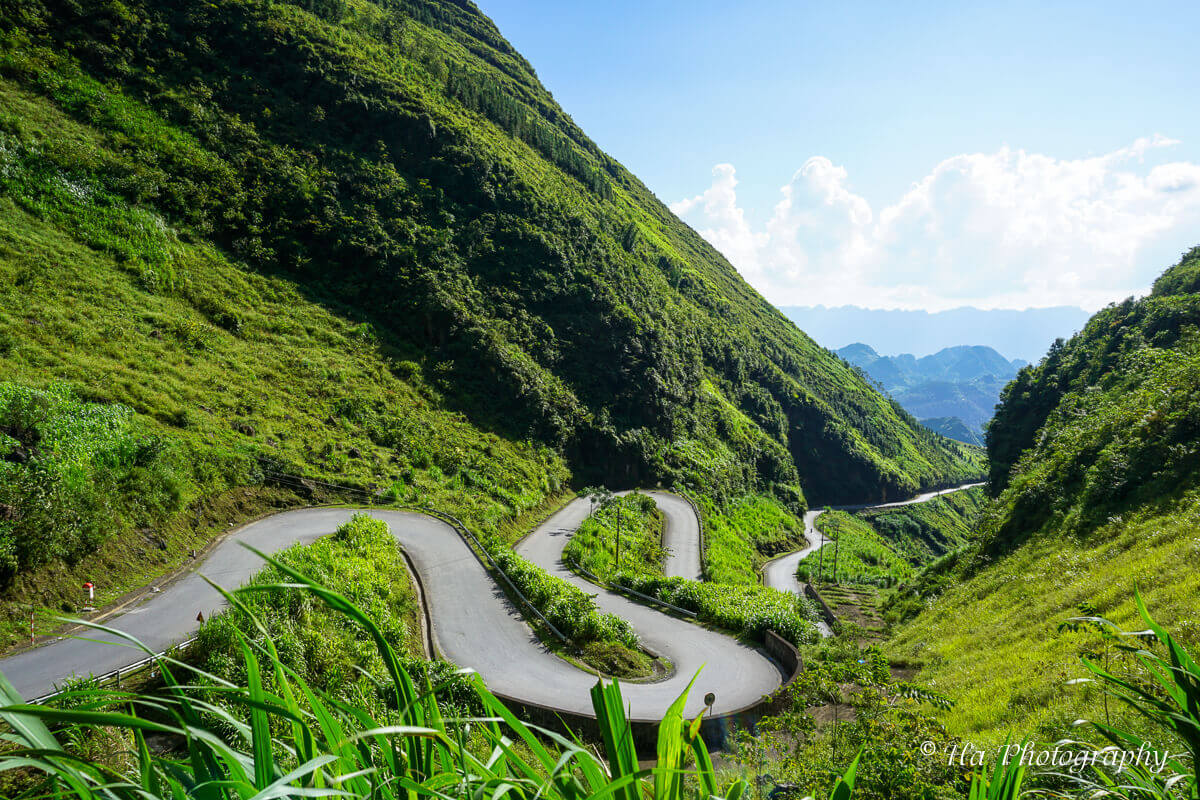
Another spot I always build into a Ha Giang trip is Tham Ma Pass. The road switches back on itself again and again as it climbs, with plenty of spots to pull over and take photos.
Visit Pao’s House
A short detour from the pass brings you to Pao’s House, a traditional Hmong house turned small museum. It’s decorated with textiles and handicrafts that give you a real sense of Hmong daily life.
I recognized it instantly from the movie it’s named after, which made the visit feel like stepping onto a film set. It’s a quick stop, but worth adding to your route.

Cross the Dong Van Karst Plateau
From here, the loop climbs onto the Dong Van Karst Plateau, a UNESCO Global Geopark where the landscape feels almost alien. Limestone peaks and deep canyons stretch out for miles, and I remember asking my driver to slow down without meaning to, just so I could keep looking at it.
The plateau is home to Hmong, Tay, and Dao communities, and you’ll likely pass locals walking the same roads you’re riding.
Wander the Hmong King Palace
Hmong King Palace, dating back to the early 20th century, is an impressive wooden structure with over 100 rooms and intricate carvings throughout. It’s now a museum covering Hmong culture and history.
I spent longer here than I expected to, mostly reading about the palace’s role in local history and the family that built it.

Stay in an ethnic homestay
Somewhere along the loop, you should plan on at least one night in a homestay rather than a hotel. It’s one of the best ways to actually get to know Ha Giang instead of just passing through it.
My hosts, a Hmong family in their traditional stilt house, were some of the warmest people I met on the whole trip. Every meal was made from whatever was fresh that day, and none of it came close to what you’d get in a restaurant back in Hanoi.
Reach Lung Cu Flag Tower
Further along, the road leads to Lung Cu Flag Tower, marking the northernmost point of Vietnam. Getting there means climbing a steep hill, but the panoramic view from the top makes the climb worth it.
From here you can actually see into China, with the border marked by a river in the distance. Standing at the edge of the country in such a remote spot is a strange feeling I haven’t quite shaken, even now.

Wander Dong Van ancient town
Back down from Lung Cu, Dong Van Ancient Town has some of the best-preserved traditional architecture in the region.
The narrow streets are perfect for an unhurried wander, and I love the carvings on the older buildings, some of them centuries old.
Time your visit for a Sunday if you can. The Dong Van market takes over the town center then, and it’s one of the liveliest scenes in the whole province.


Cruise the Nho Que river
From Dong Van, most people head down toward the Nho Que river, and it’s easily one of my favorite things to do in Ha Giang.
Towering cliffs rise straight up from the emerald water, and the boat ride is calm enough to actually take it all in.

The highlight for me was Tu San Canyon, where the river narrows between two imposing cliffs. It’s the kind of scale that photos never quite capture.
- Price: Around 100,000 to 150,000 VND per person for a shared boat, roughly $4 to $6.
- Length: About 30 minutes to an hour, depending on the route.
- How to get there: Boats leave from Xin Cai or Ta Lang boat stations, both reachable from the loop road.

Conquer Ma Pi Leng Pass
The road up from the river climbs straight into Ma Pi Leng Pass, one of the most thrilling stretches of the whole loop.
It hugs the cliff edge with hairpin turns the entire way, and even from the back seat I found myself holding on tighter than usual.
Reaching the top gives you one of the best views in the whole province. It comes with a real sense of accomplishment that sticks with you for the rest of the trip.

Browse the local markets
Beyond the passes and viewpoints, the markets are where Ha Giang’s culture really comes alive. Visiting even one or two is one of the most immersive things you can do here.
Dong Van market
The Dong Van market runs every Sunday in the heart of the ancient town. Stalls sell everything from fresh produce to handmade textiles, and the whole town center turns into one big gathering.
Meo Vac market
Meo Vac market has a similar energy, and the vendors are happy to chat if you show interest in what they’re selling. I’ve bought more souvenirs here than I probably needed to, just from talking to people.
Khau Vai love market
Khau Vai love market only happens once a year, on the 27th day of the third lunar month, in Khau Vai commune. It’s a gathering for couples who’ve had a secret relationship over the past year, with traditional dress, music, and dance you won’t see anywhere else in Vietnam.
Visit the minority villages
Between the bigger stops on the loop, Ha Giang’s minority villages are worth slowing down for. Each one is home to a distinct ethnic group with its own language, dress, and way of life. Visiting a few gave me a much deeper sense of the province than the passes and viewpoints alone.
Lo Lo Chai village
I loved wandering Lo Lo Chai‘s traditional stilt houses and watching daily life. My homestay here let me live with a local family for a night, one of the best parts of the whole trip.
If you can time it, don’t miss the annual Cau Mua festival. It features traditional music, dance, and a buffalo fighting competition that draws people from across the region.

Lao Xa village (Sung La)
A little further along, Lao Xa sits in the heart of the Dong Van Karst Plateau Geopark and is home to the Hmong ethnic minority. Skilled artisans here still hand-embroider intricate patterns the traditional way, and you can watch them work.
I recommend a short trek through the surrounding hills too. The views over the valleys and rice paddies are some of the best in the area.
Lung Tam weaving village
If you’re into traditional crafts, Lung Tam village in Quan Ba district is worth the stop. Watching artisans weave intricate patterns onto hemp and flax textiles by hand is impressive to see up close.
You can buy directly from the artisans, or visit the local Sunday market for a wider selection while supporting the community that made it.
Cool off at Du Gia waterfall
If your route brings you south toward the end of the loop, Du Gia waterfall is worth the detour. It sits surrounded by lush vegetation and towering trees, a peaceful spot after a few days of mountain roads.
I swam here on a hot afternoon, and it remains one of my favorite breaks from the whole trip. For a fuller experience, consider a homestay in Du Gia village itself rather than just passing through.
Explore the caves
Ha Giang has several caves worth exploring too, if you’re up for a bit of extra adventure beyond the roads and viewpoints.
Tham Luong cave
Tham Luong cave, near the town of Tam Son, has towering stalactites and stalagmites that make for an impressive walk-through. Get a a guided tour so you actually understand what you’re looking at, and to spot the bats living inside.
Lung Khuy cave
Lung Khuy cave is a genuine natural wonder, with underground rivers and rock formations that catch you off guard the deeper you go.
Stop by Yen Minh Pine Forest
If you want a change of scenery from limestone peaks, Yen Minh Pine Forest is a good stop. I pulled over here just to stretch my legs after a long stretch of riding, and ended up staying for lunch under the towering pines instead.
The area also has a few cultural sites nearby, including Binh Lu Market and Lung Cam Cultural Village, worth a quick detour if you have the time.
See the buckwheat flowers
The buckwheat flowers are one of the main reasons to time a Ha Giang trip for fall. From October to December, the hills and valleys turn a soft blanket of pink and white.
Quan Ba, Yen Minh, Dong Van, and Meo Vac districts are the best places to catch the display. I’ve spent whole afternoons just wandering the fields, taking photos and not doing much else.
Try the local dishes
If you’re a foodie, Ha Giang delivers just as much as the scenery does. Black chicken hotpot is one of the must-try dishes, a spicy, flavorful broth made with locally-raised black chickens and a mix of herbs and spices.
Thang Co is another local specialty, a soup made with horse meat, organs, and bones, slow-cooked for hours until the flavor runs deep. It’s not for everyone, but don’t miss it.
For something lighter, Banh Cuon, steamed rice rolls filled with pork and mushrooms, makes a great breakfast or snack. You’ll find it at markets and street stalls throughout the region.

Where to stay in Ha Giang
I like staying in Ha Giang city before starting the Loop because it keeps the next morning nice and simple. You can leave your bigger bags behind, grab breakfast, and head out without adding another transfer.
Four Points by Sheraton Ha Giang is my pick when I want a more comfortable hotel stay. It’s especially nice before or after a few busy days on the road.
Bong Hostel Ha Giang is a fun option if you’re traveling solo or want to meet other people doing the Loop. I like the social feel, and it’s an easy place to base yourself before heading into the mountains. De La Mont Hotel Ha Giang is another great choice that sits in the middle.
Compare hotels in Ha Giang City →
Ready to plan your Ha Giang trip?
Ha Giang rewards people who slow down. It’s easy to treat the loop as a checklist of viewpoints, but the best parts of my trips here have always been the unplanned moments.
If you want a broader route through the country, my two week Vietnam itinerary shows how Ha Giang fits into a longer trip. My Vietnam transportation guide covers how to get here from Hanoi.
Before you land, sort your travel insurance and Vietnam eSIM. And don’t forget the border permit, it’s a small thing that makes a big difference if you get stopped at a checkpoint.